
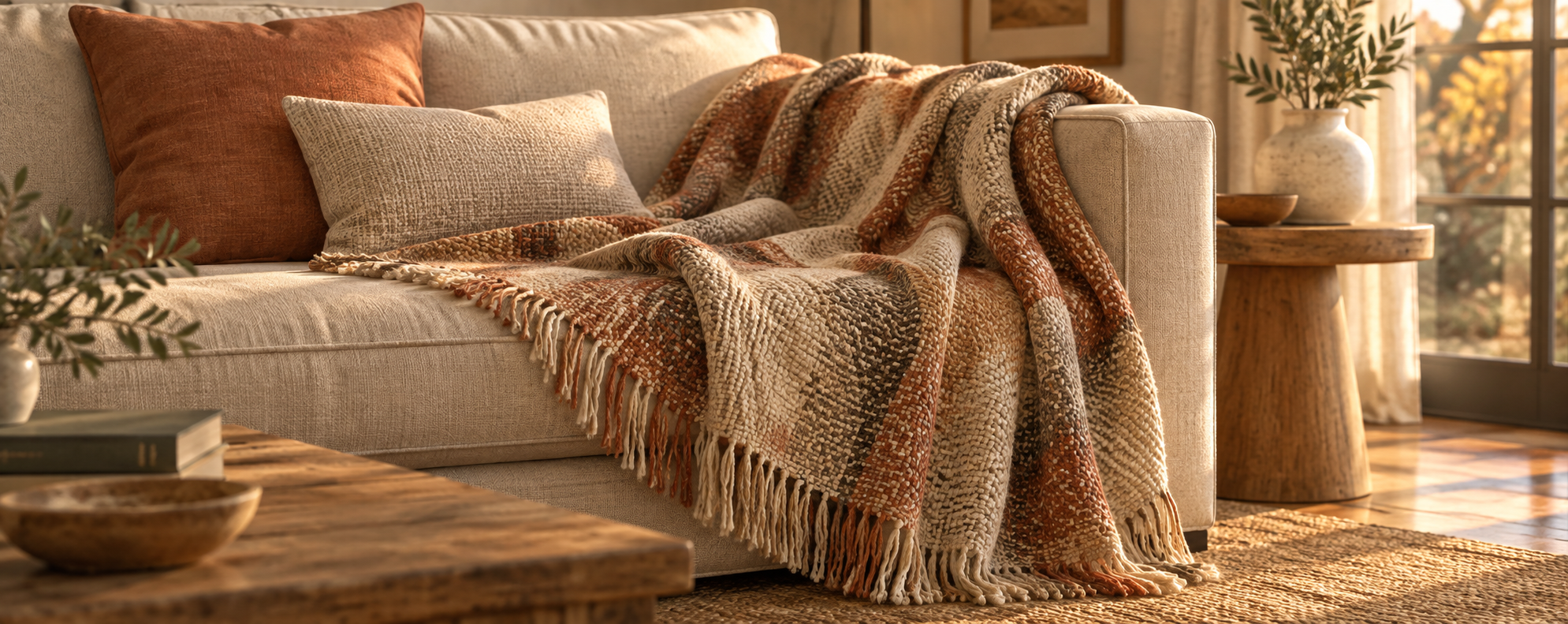
There's a reason a throw blanket on sofa shows up in almost every well-styled living room photo — it's one of the fastest, cheapest ways to make a couch look finished and lived-in at the same time. If you're searching for how to drape throw on sofa the right way, the trick isn't really about the blanket itself; it's about how you fold and place it. A few reliable techniques cover almost every couch shape and style preference.
Choosing the Right Throw Blanket for Your Couch
Before folding anything, it's worth getting the basics right, since even a perfect fold looks off on the wrong blanket.
Size relative to your couch. A throw that's too small on a large sectional looks like an afterthought; one that's too large on a loveseat overwhelms it. As a rough guide, the blanket should cover roughly a third to half of the couch's width when draped, with enough length to cascade down rather than just sitting flat on top.
Weight and texture matter more than people expect. A lightweight throw drapes into soft, natural folds. A chunkier knit, like a cable knit throw blanket or a chenille throw blanket, holds its shape more and creates a bolder, more textured look — which also means it needs a slightly different folding approach, covered below.
Color and pattern coordination. If your couch already has a busy pattern or multiple colors, a solid, neutral throw tends to look more intentional than adding another pattern on top. A solid-colored couch, on the other hand, is a good place to introduce texture or a bolder color without it competing with anything else in the room.
5 Ways to Drape a Throw Blanket Over a Couch
The Diagonal Corner Drape. Fold the blanket in half lengthwise, then drape it over one arm of the couch so it cascades diagonally down toward the seat. This is the most classic, low-effort option, and it works on almost any couch shape.
The Tri-Fold Over the Arm. Fold the blanket lengthwise into thirds, then lay it neatly over the arm so the folded edges are visible and even. This reads as more structured and tidy than the diagonal drape — a good choice if you want the blanket to look styled rather than casually tossed.
The Horizontal Back Fold. Fold the blanket into thirds and lay it along the back of the couch, running horizontally. This keeps the blanket out of the way of anyone sitting down, which makes it a practical choice for a couch that doubles as extra seating for guests.
The Cascading Half-Fold. Fold the blanket in half, then drape it so part of it rests on the back of the couch and the rest flows down onto the seat cushion. This creates a more relaxed, "lived-in" look than the tri-fold, without looking messy.
The Layered Look. Use two throws with different textures or weights — for example, a smooth throw as a base layer with a chunkier knit draped partially over it. This adds visual depth and works especially well on larger sectionals that can otherwise look a little empty with just one throw.
Styling Tips That Make It Look Intentional
A well-placed throw rarely stands alone. A couple of coordinating throw pillows placed near the blanket tie the whole look together — matching the pillow color to the blanket, or at least keeping them in the same color family, reads more cohesive than a mix of unrelated patterns. Swapping throws seasonally is also a simple, low-cost way to refresh a room: lighter colors and breathable materials in warmer months, deeper tones and heavier textures once it turns cold.
Draping a Weighted or Chunky Knit Throw
This is where a heavier couch throw behaves a little differently than a standard decorative one, and it's worth knowing before you fold. A chunky knit or weighted throw holds its shape rather than falling into loose, soft folds, so the Tri-Fold or Horizontal Back Fold methods tend to look cleaner on it than the more casual diagonal drape, which can look bulky rather than relaxed with a heavier fabric. If you're using one of YNM's knitted weighted blankets as a couch throw rather than a bedtime blanket, the added weight is actually a styling advantage — it drapes with more structure and holds its position better than a lightweight throw, so it won't slide off the arm every time someone brushes past it.
One YNM customer put this dual-purpose appeal well: she keeps her weighted blanket draped over the sofa, where it looks great as decor, and she can grab it anytime she wants the calming pressure while watching TV. That's really the advantage of choosing one of the throw blankets for couch styling from a weighted or knitted line specifically — it's decor and a functional comfort layer in one piece, rather than something purely decorative that gets shoved aside the moment you actually want to use it.
FAQ
What's the best way to drape a throw blanket on a sofa?It depends on the look you want: the Diagonal Corner Drape is the easiest and most casual, while the Tri-Fold Over the Arm gives a tidier, more structured appearance. Both work on most couch styles.
How do I drape a throw on a sofa without it sliding off?Heavier, chunkier throws (like a cable knit or weighted style) tend to hold their position better than lightweight ones. Tucking part of the fold slightly under a cushion also helps keep it in place.
What size throw blanket works best for a couch?As a rough guide, aim for a throw that covers about a third to half of your couch's width when draped, with enough length to cascade rather than lie flat.
Should couch throws match the sofa color?Not necessarily — a neutral throw works well on a patterned or multicolored couch, while a solid-colored couch has more room for a bolder or more textured throw.
Can a weighted blanket work as a couch throw?Yes, and the added weight is actually an advantage for styling: it holds its folded shape better than a lightweight throw and stays in place, while still being functional to grab and use.