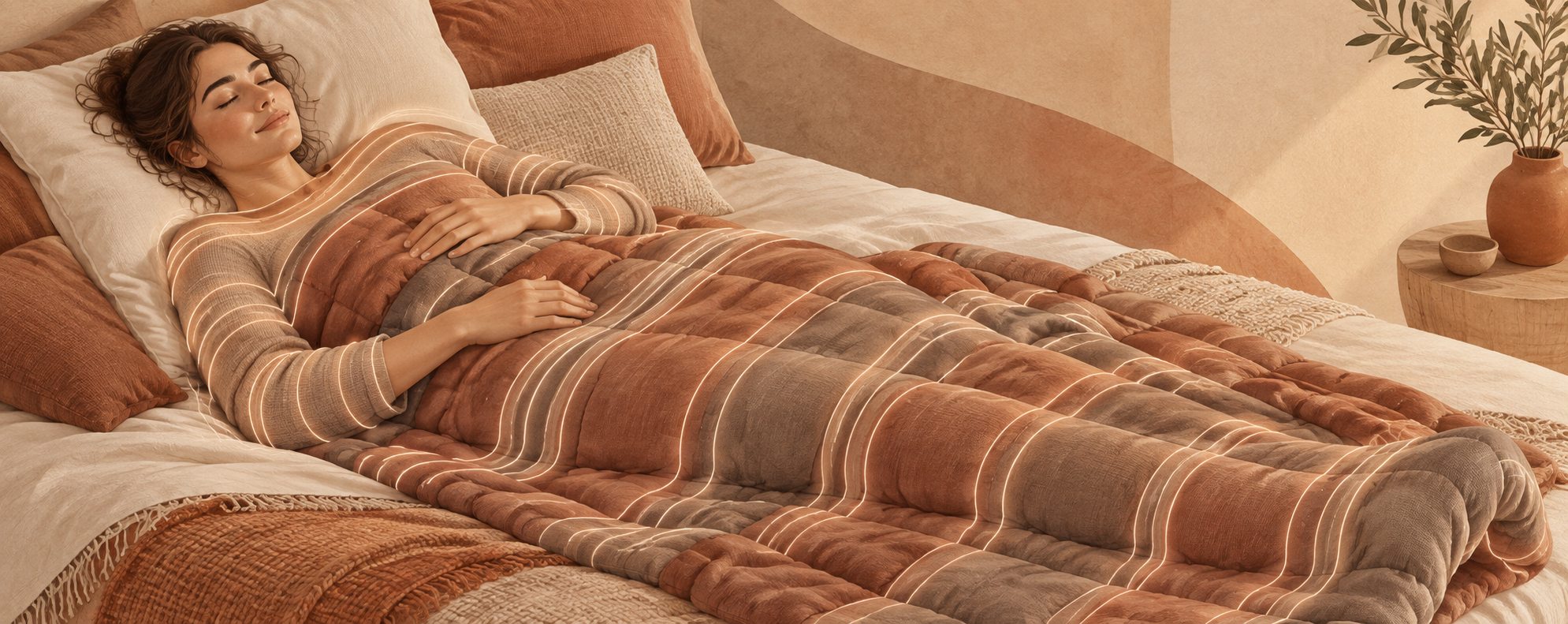

The best weighted blanket for you is one that weighs roughly 10% of your body weight, plus or minus a pound or two depending on how much pressure you like. That single number is the starting point for almost every good weighted blanket, but it isn't the whole story — your sleep position, who you're sharing a bed with, and how heavy a blanket you can comfortably move under all shape the final answer.
Get the weight wrong in either direction and the blanket stops working the way it's supposed to. Too light, and it feels like an ordinary heavy blanket with none of the calming pressure. Too heavy, and instead of feeling like a hug, it can feel restrictive — something a lot of first-time buyers learn the hard way.
What Is a Weighted Blanket, Exactly?
A weighted blanket is a blanket filled with evenly distributed weight — usually glass beads, plastic pellets, or a dense knit — designed to apply gentle, consistent pressure across your body as you sleep. That pressure is called deep pressure stimulation, a technique occupational therapists have used for decades to help calm the nervous system, originally with autistic patients and people with sensory-processing needs before it became a mainstream sleep product. The blanket itself isn't a medical device, but the mechanism behind it — steady, evenly spread pressure — is what the weight guidelines below are built around.
How Heavy Should a Weighted Blanket Be?
For most adults, the right starting point is 10% of your body weight. If you weigh 150 pounds, that's a 15-pound blanket. If you weigh 200 pounds, you're looking closer to 20 pounds. It's fine to round up rather than down if you fall between two available weights — a little extra pressure is rarely uncomfortable, while going too light just means you won't feel much of an effect.
This 10% figure isn't an exact science — it's a widely used rule of thumb rather than a strict medical formula, and it holds up well because it keeps the blanket heavy enough to feel calming without being heavy enough to restrict normal movement. Some people, especially those managing anxiety or restlessness, prefer to nudge 1–2 pounds above 10% for extra pressure. Side sleepers, on the other hand, often do better sticking closer to the lower end, since a heavier blanket can feel more restrictive when you're shifting positions through the night. The takeaway: start at 10% of your body weight, then adjust slightly based on how you actually sleep, not the other way around.
|
Body Weight |
Recommended Blanket Weight (~10%) |
|---|---|
|
90–110 lbs |
8–10 lb |
|
110–140 lbs |
10–12 lb |
|
140–170 lbs |
12–15 lb |
|
170–200 lbs |
15–18 lb |
|
200+ lbs |
18–20 lb |
YNM's weighted blanket collection spans this whole range, from a 5-pound starter option up to 50 pounds, so you're not stuck rounding to the nearest "close enough" weight. In short: a weighted blanket heavy enough to feel grounding without ever feeling restrictive is exactly what the 10% rule is designed to find.
What Happens If Your Weighted Blanket Is Too Heavy?
A blanket that's too heavy doesn't just feel less comfortable — it can genuinely make it harder to sleep. A friend of mine bought a weighted blanket based on how it looked online rather than her actual body weight, going with one of the heaviest options available because she assumed heavier meant more effective. The first night, her chest felt tight under the weight, and she found herself waking up feeling like she couldn't get a full breath. After two nights like that, the blanket ended up folded in a closet instead of on the bed.
That's a pretty common story, and it's exactly why the 10% guideline exists — a blanket that's too heavy relative to your body weight can feel constricting rather than calming, especially if you're a smaller frame, a side sleeper, or someone with any respiratory or circulation sensitivity. If a blanket ever makes it hard to breathe deeply or move freely underneath it, that's a sign to size down, not push through it.
How Do I Calculate the Right Weight for a Weighted Blanket?
Take your body weight, multiply by 0.10, and round to the nearest available weight — that's the calculation in full. A 130-pound person lands at 13 pounds, which usually means choosing between YNM's 12lb and 15lb options depending on preference. If you like a firmer, more grounding feel, round up; if you tend to run warm or move around a lot at night, round down.
Is There a Different Rule for Kids or Couples?
Yes, both cases work a little differently than the standard adult formula.
For kids, most brands and pediatric guidance recommend around 10% of the child's body weight plus 1–2 pounds, and weighted blankets generally shouldn't be used at all for children under two years old. If your child is under four or five, it's worth checking with a pediatrician or occupational therapist first, since a child's ability to move a blanket off themselves is part of what makes weighted bedding safe. YNM's kids line is built specifically around these lighter, child-appropriate weights.
For couples sharing one blanket, the math shifts because the blanket needs to work for two different body weights at once. A common approach is basing the weight on roughly 7.5% of your combined body weight rather than 10% of either person individually, though the simpler option many couples land on is just choosing the weight that suits the lighter or more sensitive sleeper, since it's easier to add warmth than to take away pressure. A King or Queen size in the 20–25 lb range tends to work for most couples who land in this range together.
Which YNM Weighted Blanket Weight Should You Choose?
Once you've settled on a target weight, the next decision is which line fits how you actually sleep. If you tend to sleep hot, the Cooling Line uses a more breathable fabric at the same weight ranges, so you're not choosing between "the right weight" and "not overheating." If you'd rather skip glass beads entirely, the Knitted Line uses a chunky hand-knit construction to create weight through the yarn itself — same deep-pressure effect, different feel and look.
Whichever line you land on, the weight calculation stays the same: start at 10% of body weight, adjust slightly for sleep style, and round up rather than down if you're stuck between two options.
FAQ
Is it bad to get a weighted blanket that's too heavy?Yes — a blanket that's significantly heavier than 10–12% of your body weight can feel restrictive rather than calming, and in some cases can make it harder to breathe deeply or reposition yourself while sleeping. If a blanket feels hard to move under, size down.
Can I round up if I'm between two weights?Generally yes. Most people tolerate slightly heavier than 10% better than slightly lighter, since a too-light blanket just won't produce much of a calming effect. If you're sensitive to weight or a smaller frame, rounding down is the safer call instead.
Do weighted blankets work the same for side sleepers?Side sleepers can still use weighted blankets comfortably, but often prefer the lighter end of their recommended range, since a heavier blanket can feel more restrictive when shifting positions during the night.
What weight should I get for a child?Around 10% of their body weight plus 1–2 pounds is the common guideline, and weighted blankets aren't recommended for children under two. For kids under four or five, check with a pediatrician first.
Is a heavier weighted blanket always better for anxiety?Not necessarily. More weight isn't automatically more effective — going past what's comfortable for your body weight tends to backfire, making the blanket feel restrictive instead of calming. Staying close to the 10% guideline, even for anxiety-focused use, is generally the better approach.