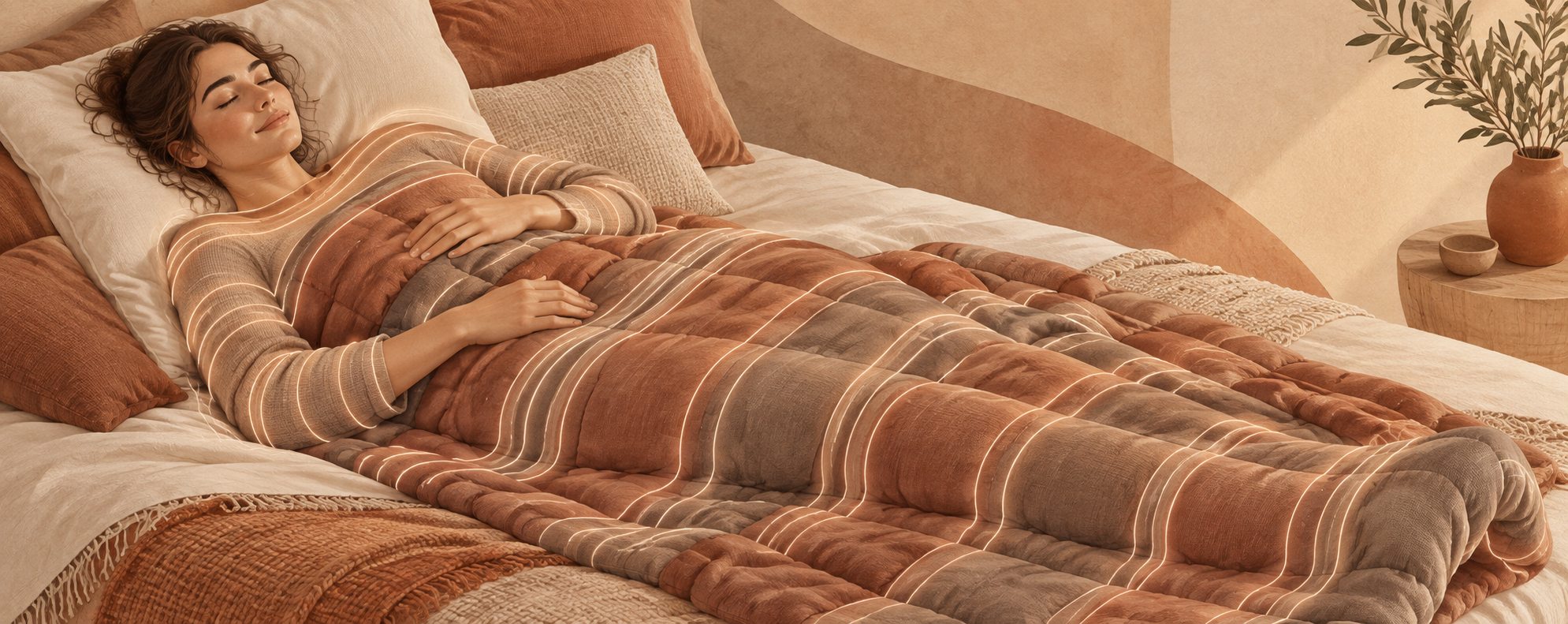
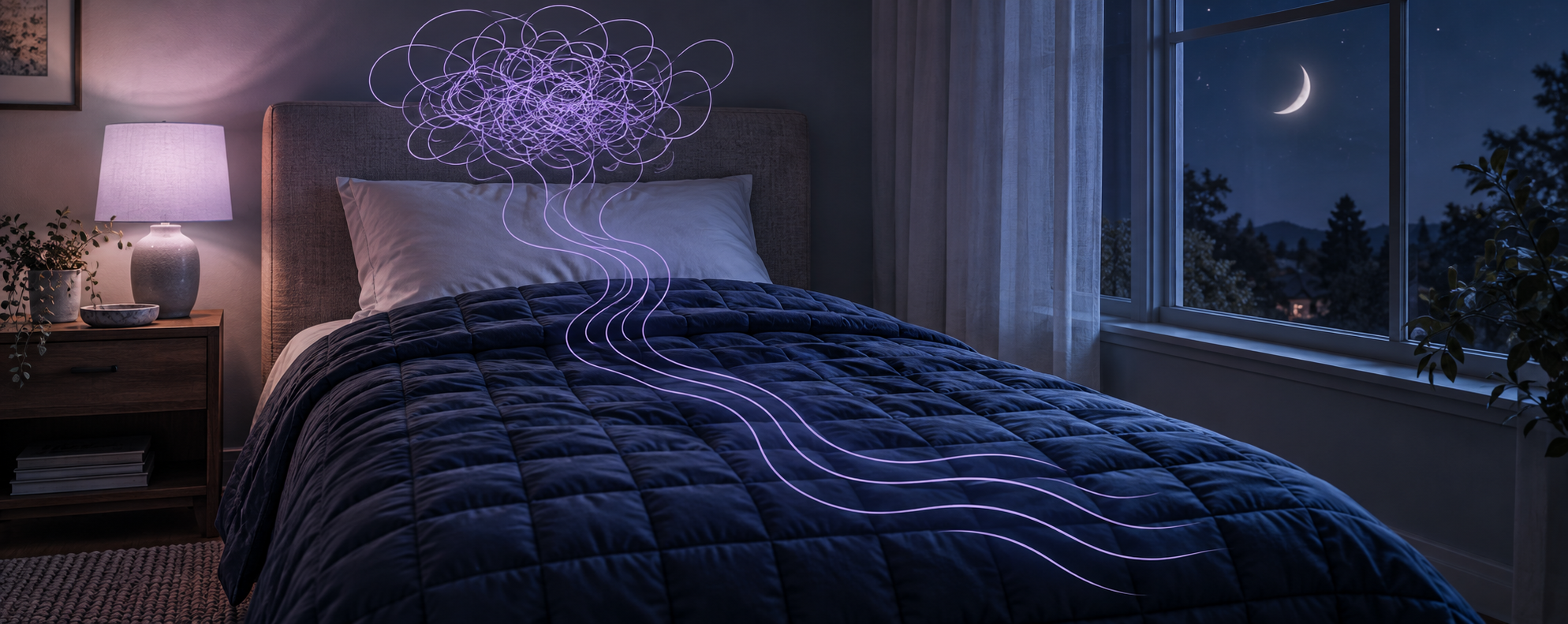
Research on weighted blanket adhd use is cautiously positive and growing, with most of the evidence pointing to sleep-related benefits — falling asleep faster, staying asleep, and feeling calmer during the day — rather than a direct effect on core ADHD symptoms like inattention or hyperactivity. This holds for both children and adults, and the research base is larger than most people expect. Multiple studies, including randomized controlled trials, have specifically measured how a weighted blanket for adhd sleep performs — while a broader and growing body of work looks at weighted blanket and adhd outcomes more generally. It's not a treatment for ADHD itself, but the evidence for it as a sleep aid is genuinely more substantial than for a lot of other sensory products marketed to this community.
What Does the Research Say About Weighted Blankets and ADHD Sleep?
A 2024 randomized controlled crossover trial published in the Journal of Sleep Research looked specifically at children with ADHD, comparing a weighted blanket against their regular blanket. It found improvements in sleep-onset latency — how long it takes to fall asleep — building on earlier open studies that had shown similar results in children.
A separate, larger study published in the Scandinavian Journal of Occupational Therapy took a broader look: 85 individuals diagnosed with ADHD and/or autism spectrum disorder, split between 48 children and 37 adults, all of whom had been prescribed a weighted blanket. Based on structured interviews, the study found real improvements in falling asleep, sleeping through the night, and relaxing during the day, with just over half of participants (59%) reporting better ability to fall asleep specifically. That's a meaningful number, though it's worth flagging that this was a retrospective study based on self-report rather than an objective sleep measurement like actigraphy.
For adults specifically, a randomized controlled trial by Ekholm and colleagues followed 120 adults with insomnia, where eligibility required a psychiatric diagnosis — ADHD, bipolar disorder, generalized anxiety disorder, or major depression. That trial found a reduction in subjective sleep disruption among participants using a weighted blanket compared to a lighter control blanket.
Does It Help During the Day, Not Just at Night?
This is where the research gets more interesting than a simple "does it help sleep" question. A qualitative study of parents of children with ADHD and sleep problems found that, beyond better sleep itself, parents described three consistent patterns: children achieved more satisfactory sleep (better sleep onset, more continuous sleep, steadier bedtime routines), reported greater overall well-being including improved relaxation and reduced anxiety, and — notably — parents described children as better able to "master everyday life," including improved balance at home, better family functioning, and fuller participation in school and leisure activities.
That last point matters for how to think about weighted blankets and ADHD generally: the research doesn't suggest a weighted blanket changes ADHD symptoms directly during the day. What it suggests is more indirect and, frankly, more plausible — better sleep at night tends to support better functioning during the day, and ADHD is a condition where sleep disruption and daytime symptoms are already closely linked. Improve one, and the other often follows.
What About Adults with ADHD?
Most ADHD research understandably focuses on children, but adult ADHD is increasingly well-studied, and weighted blankets are part of that. Beyond the Ekholm trial mentioned above, the broader Scandinavian retrospective study specifically included adults (37 of the 85 participants), which is relatively unusual — a lot of weighted blanket research on ADHD skips adults almost entirely.
One YNM customer, who has adult ADHD, described it simply: her weighted blanket helps her racing thoughts slow down at bedtime, so she can finally settle into sleep. That's a good real-world match for what the research actually shows — not that racing thoughts stop, but that the pressure helps create enough calm to fall asleep despite them, which lines up with the deep pressure stimulation mechanism behind all of this: firm, even pressure that's associated with shifting the nervous system toward a calmer, more parasympathetic state.

What the Evidence Doesn't Yet Show
It's worth being honest about the limits here, since ADHD research on weighted blankets is still a developing field. A 2024 systematic review and meta-analysis of weighted blankets in psychiatric populations specifically noted that no included study used a weighted blanket as the sole treatment for the underlying condition — every study treated it as a complementary tool, not a standalone intervention. A newer randomized controlled trial protocol, still underway as of 2025, is specifically designed to measure ADHD core symptoms alongside sleep outcomes using actigraphy, which suggests researchers themselves consider the core-symptom question still open. And it's worth noting that results vary by condition — a separate trial in children with autism spectrum disorder (a different but sometimes co-occurring condition) found no objective sleep improvement on actigraphy, even though both parents and children in that study still preferred the weighted blanket over their regular one.
The honest summary: weighted blankets have real, multi-study support as a sleep aid for people with ADHD, both children and adults, and there's growing (though not yet conclusive) evidence they support daytime functioning indirectly through better sleep. They are not shown to treat ADHD's core symptoms directly, and no legitimate study treats them as a replacement for standard ADHD care.
What to Look for in the Best Weighted Blanket for ADHD
The starting point is the same weight formula used for any weighted blanket — roughly 10% of body weight, plus about a pound — which our full weight guide walks through in detail. For a child, YNM's Kids Line is sized and weighted specifically for smaller sleepers rather than just a lighter version of an adult blanket. For adults, the full Weighted Blanket Line covers the wider range most adult ADHD sleepers will need.
Construction matters too, especially for anyone who moves around a lot at night, which is common with ADHD. A blanket with small, individually stitched pockets keeps the fill from migrating to one side as you shift positions; if you'd rather avoid loose fill altogether, a knitted weighted blanket carries its weight in the yarn itself instead.
FAQ
Do weighted blankets actually help with ADHD?Research supports them as a sleep aid for people with ADHD — helping with falling asleep, staying asleep, and daytime relaxation — but they aren't shown to treat core ADHD symptoms like inattention or hyperactivity directly.
Is there research on weighted blankets and ADHD sleep specifically?Yes — several studies, including a 2024 randomized controlled crossover trial in children and a retrospective study covering both children and adults, have looked specifically at sleep-onset latency and overall sleep quality in people with ADHD.
What is the best weighted blanket for ADHD?The right weight is roughly 10% of body weight plus a pound, sized appropriately for a child or adult. Construction with small, stitched pockets (or a knitted, bead-free design) helps if the person moves around a lot at night, which is common with ADHD.
What are the benefits of a weighted blanket for ADHD beyond sleep?Parents in qualitative research described better daytime relaxation, reduced anxiety, and improved participation in school and family life — though this appears to be an indirect effect of better sleep rather than a direct effect on ADHD symptoms themselves.
Can adults with ADHD use a weighted blanket, or is it just for kids?Adults are increasingly included in the research, not just children — studies specifically covering adults with ADHD have found reduced sleep disruption and improved sleep quality.